Festival— summer
Morioka Sansa Odori: The World's Largest Taiko Drum Parade
June 26, 2026
Each August, Morioka turns its main avenue over to thousands of drummers. The Sansa Odori holds a Guinness World Record for the most taiko drums played at once, but its real subject is a city dancing for itself.
For four evenings in early August, the center of Morioka belongs to the drum. The Sansa Odori fills Chuo-dori, the city's wide downtown avenue, with thousands of taiko players, dancers, and flute musicians moving in unhurried procession. The sound arrives before the parade does, a low collective pulse that can be felt through the pavement.
It is easy to reduce the festival to a statistic. In 2007 the Sansa Odori entered the Guinness World Records for the most Japanese drums played simultaneously, and the city has worn the title comfortably ever since. But the record undersells what is actually happening on the street. This is not a performance staged for visitors so much as a community in motion, a capital of Iwate Prefecture rehearsing its own gratitude in public.
What the Sansa Odori Actually Is
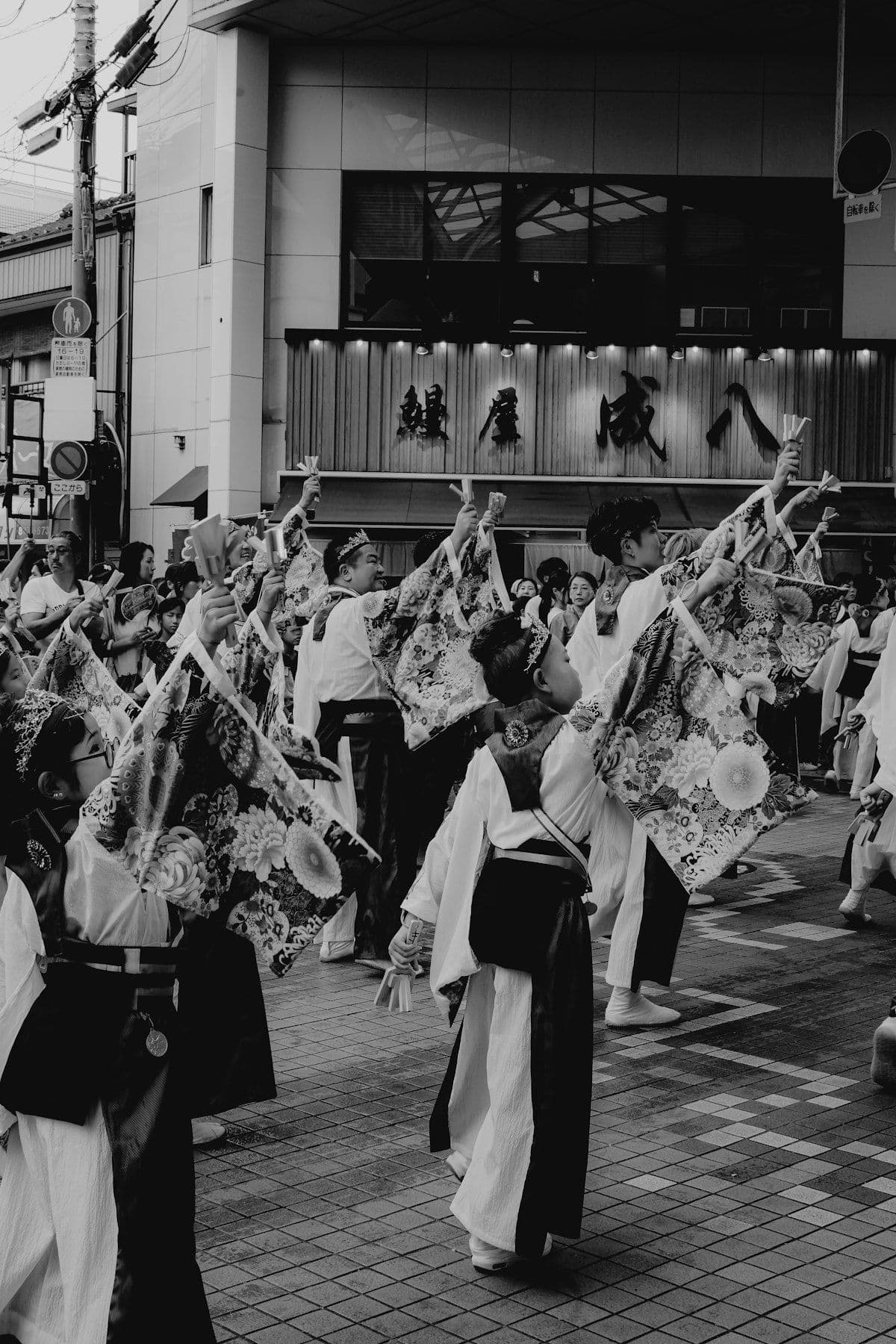
The Sansa Odori is Morioka's summer festival, held annually from August 1 to 4. Over those four nights, groups from across the city and surrounding region assemble in sequence and parade down Chuo-dori in the early evening, typically beginning around six o'clock and continuing for several hours. Each group is its own small ecosystem: ranks of drummers carrying barrel-shaped taiko slung across the body, lines of dancers in matching summer yukata, and flute players threading a high melody over the percussion.
The dance itself is deliberately accessible. The basic steps are simple, repetitive, and built to be learned, which is part of the point. Neighborhood associations, schools, companies, and amateur clubs spend weeks practicing, and the result on the avenue is less a polished spectacle than a city's worth of people who have agreed to move together. The atmosphere is warm rather than grand. Children march beside grandparents; office teams in coordinated happi coats follow troupes who have danced for decades.
That communal character distinguishes the Sansa Odori from the more famous Tohoku summer festivals. Where some events are built around a single dramatic image, a great lantern or a towering float, this one is built around participation. The crowds lining Chuo-dori are watching neighbors, not strangers, and the energy reflects it. There is applause when a particularly tight troupe passes, but also the quieter pleasure of recognizing a familiar face among the dancers. The festival belongs to the people in it, and the spectators are simply the participants who have not yet stepped in.
The Guinness Record and the Sound of Thousands of Drums
The festival's headline distinction is acoustic. On a single night in 2007, the Sansa Odori set a Guinness World Record for the most taiko drums played at the same time, a feat involving several thousand players. In the years since, the simultaneous count has grown well beyond the original mark, with the festival routinely fielding upward of three thousand four hundred drums in its mass performances.
The number matters less than the physical experience of it. A single taiko is a powerful instrument; thousands struck in loose unison produce something closer to weather than music. The beat is steady and round-bodied, more felt than heard at close range, and it gives the whole parade its forward momentum. Dancers do not so much follow the drums as ride them. Standing at the curb as a large group approaches, a spectator first registers the sound as a pressure in the chest, then as a rhythm, and only then as a procession of individual players. The order of that perception, body before ear before eye, is much of what makes the festival memorable.
How the drumming is organized
Each parading group keeps its own rhythm section, so the avenue carries a moving patchwork of overlapping beats rather than one metronomic pulse. The drums are carried, not wheeled, which means every player is also walking the full route. The discipline this requires, hours of striking a heavy instrument while marching in step, is one of the quieter achievements on display, easy to miss beneath the obvious volume.
Itinerary
Morioka Travel Guide: The City the New York Times Put on the Map
A Morioka travel guide to Iwate's capital: castle ruins and red-brick banks, a celebrated three-noodle food culture, the looming cone of Mt. Iwate, and an old-school coffee and jazz scene.
The Legend Behind the Name: Rock, Hand, and Iwate
The festival's name and its meaning reach back to an old local legend tied to Mitsuishi Shrine in Morioka. The story goes that a demon named Rasetsu once terrorized the area. The townspeople prayed to the shrine's deity for protection, and the demon was eventually subdued and made to swear that it would never return.
To seal the promise, the demon pressed its hand into a great rock at the shrine, leaving an imprint behind. From that act, the tradition holds, comes the name of the prefecture itself: Iwate, written with the characters for rock and hand. Relieved of the demon's menace, the townspeople are said to have danced around the rock in celebration, chanting in joy. That chant, rendered as "sansa," gives the festival its name and frames the whole event as a dance of thanksgiving rather than mere revelry.
Whether or not one takes the legend literally, it supplies the Sansa Odori with a coherent emotional center. The festival is, by its own account, a celebration of relief and gratitude, and the open, communal way it unfolds on Chuo-dori is consistent with that origin. Visitors who stop at Mitsuishi Shrine, a short distance from the city center, can see the rocks said to anchor the story.
The Participatory Finale
The most telling moment of each evening comes at the end. After the organized groups have passed, the parade dissolves into an open dance circle, and the boundary between performer and spectator simply disappears. Onlookers who have spent the evening at the edge of the avenue are invited to step in and join, and many do.
This is where the festival reveals its priorities. The finale is not a closing ceremony to be watched but an invitation to be accepted. The steps are easy enough to pick up in a few minutes, the regulars are forgiving, and the drumming carries newcomers along. For a visitor, joining the circle is the difference between having seen the Sansa Odori and having been in it, and the festival is plainly designed to make the second option available to anyone willing.
It is a fitting expression of Morioka's broader temperament. The city drew international attention when it appeared near the top of The New York Times list of 52 places to go, praised for its walkable scale and unpretentious charm. The Sansa Odori is that same character set to a drumbeat: confident, welcoming, and uninterested in performing for approval.
When and Where: Access and Practical Notes
The Sansa Odori runs every year from August 1 to 4, with the parade along Chuo-dori beginning in the early evening, around six o'clock, and continuing into the night. The avenue sits in central Morioka, an easy walk from Morioka Station, which is served directly by the Tohoku Shinkansen from Tokyo in roughly two and a quarter hours. That fast rail connection makes the festival unusually approachable for a Tohoku summer event, reachable as a long day trip though far better enjoyed with an overnight stay. Because the four festival nights fall within the busy summer travel season, accommodation in the city books up well ahead, and securing a room near the center is worth doing early. Visitors building a wider itinerary often pair Morioka with the temples and gardens of Hiraizumi to the south or the rugged coastline farther east, using the city as a comfortable base in the heart of Iwate.
Getting a good vantage point
Spectating is free, and much of the route along Chuo-dori is open to standing crowds. Reserved seating is sometimes made available; arriving an hour or so before the evening's start gives a comfortable margin to settle in along the curb. The weather in early August is warm and humid, so light clothing, water, and a hand fan are sensible. Because the drumming is genuinely loud at close range, families with very young children may prefer a position set back from the front rank.
Eating around the festival
Morioka is a noodle town, and festival season is an ideal moment to work through its trio of signature dishes: wanko soba, served in a rapid succession of small bowls; jajamen, flat noodles dressed with a savory meat-and-miso sauce; and reimen, the cold, chewy, faintly spicy noodles that are a summer staple. Downtown noodle houses sit within walking distance of the parade route, and an early dinner before the six o'clock start is a practical way to anchor the evening.
Frequently Asked Questions
When is the Morioka Sansa Odori held?
The festival takes place every year on the same four dates, August 1 to 4, in central Morioka. The parade along Chuo-dori begins in the early evening, generally around six o'clock, and continues for several hours into the night. Planning to arrive in the city by late afternoon allows time for dinner and for finding a good place along the route before the drumming starts.
Why does the Sansa Odori hold a Guinness World Record?
In 2007 the Sansa Odori was recognized by Guinness World Records for the most Japanese taiko drums played simultaneously. The mass performance has only grown since, with the festival now fielding well over three thousand drums at once. The record reflects the festival's defining feature: enormous numbers of drummers playing together, producing a collective sound that gives the entire parade its momentum.
Can visitors join the dancing?
Yes. At the end of each evening the organized parade opens into a public dance circle, and spectators are welcomed to join. The basic steps are simple and easy to learn on the spot, and the festival is structured to make participation easy rather than to keep visitors at a distance. Joining the circle is widely considered the best way to experience the Sansa Odori.
What does the name Sansa Odori mean?
The name comes from a local legend connected to Mitsuishi Shrine. After a demon was subdued and pressed its hand into a great rock to promise never to return, the townspeople are said to have danced in gratitude while chanting "sansa." The same legend is held to explain the name of Iwate Prefecture, written with the characters for rock and hand, after the demon's handprint on the stone.