Festival— summer
Yamagata Hanagasa Festival: The Dance of the Flower-Hats
June 27, 2026
Each August, thousands of dancers fill the heart of Yamagata city for the Hanagasa festival, twirling flower-hats crowned with the red safflower that built the region's fortunes. This is the story behind the dance, the blossom, and Tohoku's great summer.
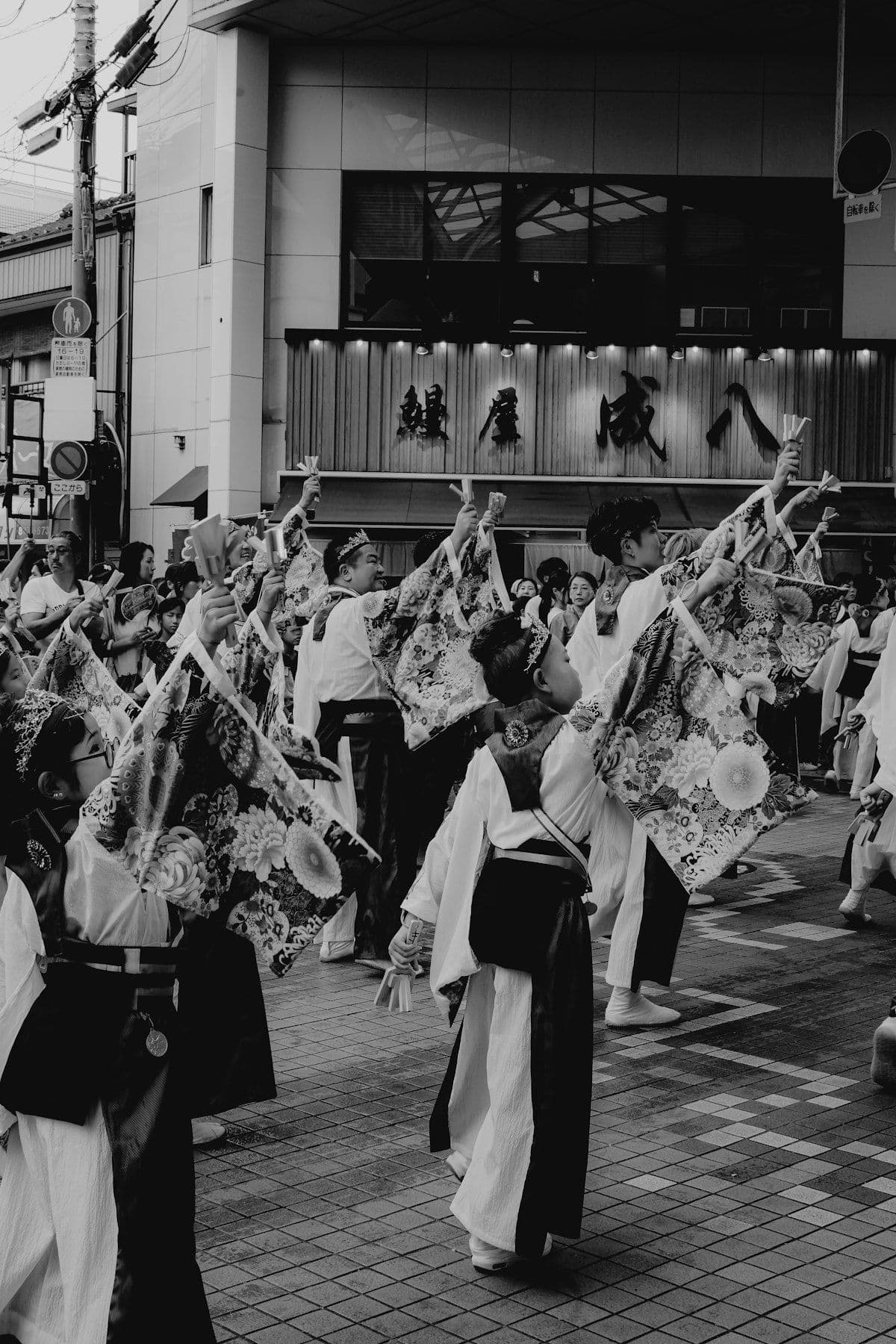
The sound arrives before the sight. A drumbeat rolls down Nanokamachi Odori, and then a cry rises from hundreds of throats at once: "Yassho, Makasho!" Moments later the dancers appear, a river of color moving in unison, each one lifting a straw hat ringed with vivid red flowers toward the summer dusk.
This is the Hanagasa festival, one of the four great summer matsuri of Tohoku and the centerpiece of early August in Yamagata city. Where the region's other famous celebrations reach back centuries, this one is comparatively young, formalized in the early 1960s. Yet it draws on something far older: the rhythms of farm and field, the labor of clearing irrigation ponds, and the deep cultural memory of a flower that once made Yamagata rich. To understand the dance is to understand the place.
The Dance and the Flower-Hats
At the center of everything is the hanagasa itself, the "flower-hat" that gives the festival its name. The base is a sugegasa, the conical or shallow woven straw hat long worn by farmers across Japan for shade and shelter. What transforms it is the decoration: clusters of red safflower blossoms, the benibana, arranged around the brim so that the whole hat seems to bloom. In motion, a thousand of these hats catch the light and become a single shifting field of red and gold.
The choreography is built on the hat. Dancers raise it, spin it, lower it, and sweep it through the air in broad arcs, the movements crisp and synchronized within each troupe. The steps are not difficult to read, which is part of the appeal; spectators can follow the pattern and feel the pulse of it. Yet the precision required to keep hundreds of dancers turning their hats as one is considerable, and the larger company groups rehearse for weeks.
Movements Drawn from Work and Water
The dance did not appear from nothing. Its motions are widely understood to derive from old work songs and folk movements tied to the agricultural calendar, in particular the labor of maintaining tameike, the irrigation reservoirs that fed Yamagata's rice fields. The gestures of hauling, digging, and clearing were stylized over time into something rhythmic and communal, the way work songs everywhere transform the grind of effort into shared cadence. When the festival was organized in its modern form, these older folk elements were gathered and shaped into the unified Hanagasa Ondo dance now performed.
Several regional variations have developed since. Alongside the standard, dignified form, troupes perform more dynamic and creatively choreographed versions, and the procession deliberately mixes styles so that the parade never settles into monotony. Children's groups, neighborhood associations, companies, and schools all take part, which gives the event the texture of a whole city in motion rather than a staged performance.
Benibana: The Red Flower Behind the Festival
The flower on the hats is not chosen for prettiness alone. The safflower, or benibana, is the symbolic flower of Yamagata Prefecture, and its history is woven through the region's economy and identity. From the Edo period onward, Yamagata was one of Japan's foremost producers of safflower, whose petals yield a precious red dye prized for coloring textiles, lacquer, and the cosmetics worn in Kyoto and Edo.
That trade depended on water as much as on soil. Harvested and processed into compact cakes of pigment, Yamagata's benibana traveled down the Mogami River, the great waterway that runs through the prefecture, to ports on the Sea of Japan and onward to the markets of the old capital. The wealth that flowed back upriver helped build the merchant towns and storehouses still visible in the region today. Safflower red was, for a time, one of the most valuable things the inland north could send to the rest of Japan.
To crown the dancers' hats with benibana, then, is to wear the prefecture's own emblem and its prosperity. The festival is in part a celebration of that heritage, a midsummer reminder of the flower that gave Yamagata both its color and its place in the wider commerce of the country. Real safflower blooms in early summer, so the hats worn in the parade typically use artificial flowers built to last the three nights, but the meaning carries regardless.
Festival
The Complete Guide to Tohoku's Three Great Festivals
Three of Japan's greatest festivals. Five days in August. One shinkansen line. Here is how to plan a trip around Nebuta, Kanto, and Tanabata.
The Music, the Cry, and the Atmosphere
The festival moves to a single song, the Hanagasa Ondo. Its melody, carried by drums, flute, and shamisen and anchored by a steady, insistent beat, repeats through the evening until it lodges itself in the listener's memory. The drums are the engine of the thing; their low pulse can be felt in the chest from the roadside, and it is the drum that keeps the long columns of dancers turning together.
Punctuating the music is the call that defines the night: "Yassho, Makasho!" Shouted by dancers and answered by the crowd, it has no tidy translation, functioning instead as a cry of effort and encouragement, the kind of rhythmic shout that work crews and festival processions have used across Japan to move in time. Hearing thousands of voices land on it together, beat after beat, is the moment many visitors remember most.
What an Evening Feels Like
The parade unfolds along a roughly one-kilometer stretch of central Yamagata city in the cooling hours of the evening, the heat of the August day finally easing. Lantern light and the glow of the city center wash over the procession. Spectators line both sides of the route, some in light summer yukata, many with cold drinks in hand, and the food stalls and side streets carry the familiar warmth of a Japanese matsuri. Because the dance is communal rather than competitive in spirit, the mood is generous; in some stretches the organizers open the route to let onlookers join, turning watchers into participants.
Where the Hanagasa Festival Sits in Tohoku's Summer
Early August is the great festival season of northern Japan, when the region's largest celebrations land within days of one another and travelers string them together into a single journey. The Hanagasa festival is counted among the big four of the Tohoku summer, alongside the Nebuta of Aomori with its illuminated floats, the Kanto of Akita with its towering poles of paper lanterns, and the Tanabata of Sendai with its cascading streamers.
Each has a distinct character. Where Nebuta is fierce and Kanto is a feat of balance, Hanagasa is the dancing festival, the one defined by human movement en masse rather than by built spectacle. Its dates, August 5 to 7, dovetail neatly with its neighbors, and the cities are linked by Tohoku's rail network, which makes a multi-festival itinerary genuinely practical for those willing to plan ahead and book early.
Yamagata also rewards visitors who stay beyond the parade. The mountain temple of Yamadera, with its stone steps climbing through cedar to a cliffside hall, lies a short train ride away and offers a contemplative counterpoint to the festival crowds. The Zao region, famous in winter for its snow-rimed trees, turns to cool highland hiking and hot springs in summer. A trip built around the festival can easily become a fuller portrait of the prefecture.
When, Where, and How to Visit
The Hanagasa festival is held annually in Yamagata city on August 5, 6, and 7, with the main parade taking place in the evening, generally beginning in the early evening and running for a few hours each night. The route follows central avenues near Yamagata Station, including the Nanokamachi and Hatagomachi area, putting the action within easy walking distance of the city's main hub.
Getting There
Yamagata Station is reached directly from Tokyo by the Yamagata Shinkansen, a ride of a little under three hours, which makes even a day trip conceivable for the determined, though staying overnight is far more rewarding. The station sits within walking distance of the parade route, and the compactness of central Yamagata is one of the festival's quiet advantages over its larger-city counterparts.
Practical Tips
Accommodation in Yamagata city fills early for the festival nights, and rooms across the region tighten during the broader Tohoku festival week, so booking well in advance is essential. Arrive ahead of the start time to claim a good vantage point along the route, bring water and a hand fan against the lingering evening heat, and consider basing yourself in Yamagata to combine the festival with Yamadera or Zao. As with any large event, confirm the current year's exact times and route before you go, as details can shift from year to year.
Frequently Asked Questions
When is the Yamagata Hanagasa festival held?
The festival takes place every year on August 5, 6, and 7 in Yamagata city. The main event is the evening parade, which runs along central avenues near Yamagata Station for a few hours on each of the three nights. Visitors should confirm the specific year's start times and route in advance, as they can vary slightly.
What are the flower-hats made of, and why safflowers?
The hanagasa is a woven straw farmer's hat decorated with red safflower, or benibana, blossoms. Safflower is the symbolic flower of Yamagata Prefecture and the source of a valuable red dye that drove the region's economy in the Edo period, carried to market down the Mogami River. Because real safflower blooms earlier in the summer, the hats in the parade usually use durable artificial flowers.
How does the Hanagasa festival compare to Tohoku's other summer festivals?
It is counted among the four great Tohoku summer festivals, together with Aomori's Nebuta, Akita's Kanto, and Sendai's Tanabata. While those festivals are known for illuminated floats, balanced lantern poles, and paper streamers respectively, Hanagasa is the dancing festival, defined by thousands of synchronized dancers and their flower-hats moving to the Hanagasa Ondo.
What else is worth seeing in Yamagata around the festival?
Yamagata city is a convenient base for two of the prefecture's signature sights. The mountain temple of Yamadera, reached by a short train ride, offers a steep stone ascent to cliffside halls and sweeping views. The Zao highlands, famous for winter snow but pleasant for hiking and hot springs in summer, lie nearby. Both pair well with a festival visit for a fuller experience of Yamagata.