Nature— all
Lake Tazawa: Japan's Deepest Lake and the Akita Highlands
June 7, 2026
Lake Tazawa in Akita is the deepest lake in Japan, a cobalt-blue caldera ringed by mountains. A guide to its legend, its golden statue, and its role as the gateway to Nyuto Onsen.
Lake Tazawa is the deepest lake in Japan, and it looks it. The water of this caldera in central Akita drops to 423 metres, and the depth gives the surface a cobalt intensity that changes from turquoise at the shallows to near-black at the centre. It is so deep that it never freezes, even in Akita's severe winters.
For travellers, Tazawako — as it is known in Japanese — is both a destination and a gateway: a near-perfect circle of blue ringed by mountains, and the jumping-off point for the hot springs of Nyuto and the samurai streets of Kakunodate.
Japan's Deepest Lake
Tazawa formed in a volcanic caldera, which accounts for both its depth and its almost circular shape, about twenty kilometres around. The extraordinary clarity and colour of the water were once even greater; an acidic river was diverted into the lake in the 1940s for hydroelectric power, which altered its chemistry and ended its native fish population. Restoration efforts continue, and the lake remains one of the most striking bodies of water in Japan.
A road circles the entire lake, with viewpoints, beaches, and rest stops along the way. In summer the shallows near the shore are clear and inviting; in autumn the surrounding mountains turn colour above the blue water; and in winter the snow-covered peaks reflect in a surface that refuses to ice over.
The Legend of Tatsuko
On the western shore stands the lake's most famous sight: a gilded bronze statue of a young woman named Tatsuko, gleaming gold against the blue. The legend says Tatsuko was a village beauty who prayed for eternal youth and was transformed into a dragon that descended into the lake, where she is said to dwell still — one explanation old storytellers gave for why the lake is so deep and never freezes. The statue, placed in 1968, has become the symbol of Tazawako and the most photographed point on its shore.
Nearby, the small vermilion Gozanoishi Shrine sits at the water's edge with a torii gate framing the lake — another favourite stop on the circuit, and a reminder of how long this place has been regarded as sacred.
Onsen
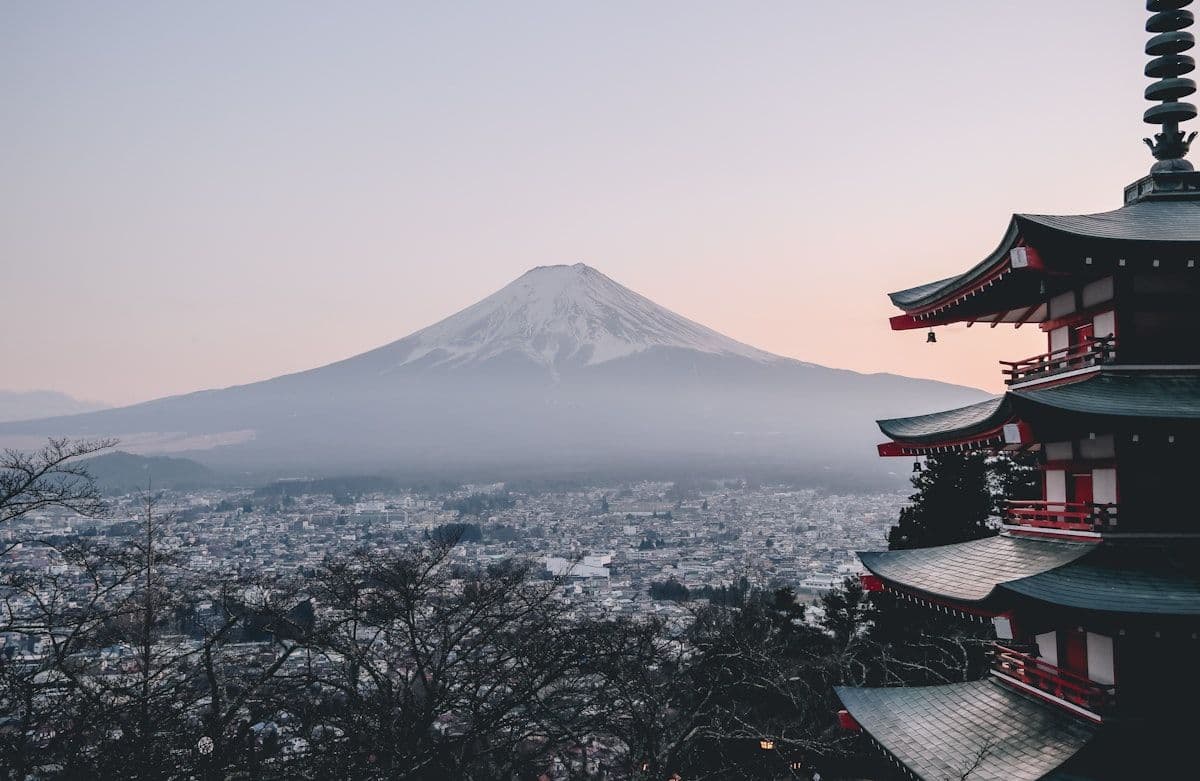
Nyuto Onsen: The Thatched-Roof Baths at the End of the Mountain Road
Seven ryokan, seven springs, one mountain in Akita. Nyuto Onsen is Japan's finest onsen district — and one of its least internationally known.
What to Do Around the Lake
In the warmer months the lake supports cycling on the perimeter road, kayaking and swimming at the beaches, and pleasure-boat cruises from the main pier. The surrounding highland is laced with hiking trails, and the Tazawako ski area on the slopes of Mount Akita-Komagatake operates in winter, with the volcano itself offering one of Tohoku's most rewarding alpine-flower hikes in summer.
Most visitors, though, come for the simplest pleasure: driving or cycling the shoreline, stopping at the statue and the shrine, and watching the colour of the water shift with the light and the depth.
Gateway to Nyuto Onsen and Kakunodate
Tazawako's practical value is its position. The lake sits a short distance from Nyuto Onsen, the celebrated cluster of seven mountain ryokan, and many travellers see the lake by day before retreating to the milky baths of Tsurunoyu by night. Kakunodate, the best-preserved samurai district in Tohoku, is only about fifteen minutes away by train. Few places in the region pack so much variety into so short a radius.
This makes Tazawako an efficient base for a two- or three-day exploration of central Akita — lake, hot springs, and samurai town — without long transfers between them.
Getting to Lake Tazawa
Tazawako Station is on the Akita Shinkansen, about three hours from Tokyo and a short branch from Morioka. The lake itself is roughly fifteen minutes from the station by bus or car. Buses connect the station, the lakeshore, and Nyuto Onsen, though a rental car gives the most freedom to circle the lake and explore the highlands.
Allow at least half a day for the lake alone, or build it into a longer stay that takes in the hot springs and Kakunodate. However it is approached, Tazawa rewards the journey with a colour of blue found nowhere else in Tohoku.
Questions Travelers Ask About Lake Tazawa
Why is Lake Tazawa famous?
Lake Tazawa is the deepest lake in Japan at 423 metres, known for its intense cobalt-blue water that never freezes, the golden Tatsuko statue on its shore, and its position as a gateway to Nyuto Onsen and Kakunodate.
How do you get to Lake Tazawa?
Take the Akita Shinkansen to Tazawako Station, about three hours from Tokyo or a short branch from Morioka. The lake is about fifteen minutes from the station by bus or car.
What is there to do at Lake Tazawa?
Visitors circle the lake by car or bicycle, stop at the Tatsuko statue and Gozanoishi Shrine, swim or kayak in summer, hike the surrounding highlands, and use it as a base for nearby Nyuto Onsen and Kakunodate.