Nature— all
Geibikei and Genbikei: Iwate's Two River Gorges
June 13, 2026
Two gorges in Iwate share almost the same name and confuse travelers constantly. This guide separates the Geibikei gorge boat ride from the rushing water and flying dango of Genbikei, and shows how to pair both with Hiraizumi.
Two gorges in southern Iwate sit barely ten kilometers apart, and their names differ by a single sound. Geibikei and Genbikei. Travelers routinely book one expecting the other, and the disappointment is avoidable. The two places are nothing alike.
One is a slow river you ride. The other is a fast river you walk beside. The Geibikei gorge is experienced from a flat-bottomed wooden boat poled upstream between limestone walls, calm enough that a boatman can sing as he works. Genbikei is a short, turbulent stretch of the Iwai River where water churns over rock, and where a shop on the far bank fires skewers of dango across the current on a rope.
Both lie within easy reach of Ichinoseki, the gateway station for this corner of Iwate, and both pair naturally with the temples of Hiraizumi. Sorting out which is which, and which suits a given traveler, takes only a moment once the difference is clear.
Geibikei Gorge: A River You Ride
The Geibikei gorge runs along the Satetsu River, a tributary that has carved a deep, quiet channel through limestone. The defining feature here is stillness. The water moves slowly, the gorge is narrow, and cliffs rise to roughly fifty meters on either side. There is no road through it and no path along its floor. To see the gorge properly, you take the boat. That single constraint shapes the entire visit: the pace is the boat's pace, and there is nothing to do but watch the walls go by.
The boat and the boatman's song
The vessels are long, flat-bottomed wooden craft, open to the air and poled rather than powered. A single boatman stands at the stern and pushes the boat upstream against the gentle current, then lets it drift back down on the return. The round trip covers about ninety minutes, including time at the upstream turning point where passengers can disembark briefly. Seating is on the boat floor, often around low tables, and the open sides leave nothing between passengers and the cliffs.
What lingers in most accounts is the singing. Boatmen here have long performed Geibi Oiwake, a regional folk song, letting their voices carry up the limestone walls where the acoustics do the rest. It is not staged in any heavy sense; the song belongs to the work, the way a poled boat and a narrow canyon seem to invite it. The effect, with cliffs sliding past and water barely whispering at the hull, is closer to a procession than a sightseeing trip.
Undama and the cliff with a hole
Near the upstream end, the gorge offers its small ritual. Visitors can buy undama, lucky clay pellets, and try to toss them into a hole worn into the far cliff face. The pellets are marked with characters standing for fortunes such as love, health, and longevity, and landing one in the opening is said to grant the corresponding wish. Most throws fall well short and vanish into the river, which is rather the point. The game gives the turning point a focus and sends visitors back to the boat amused rather than reverent.
Genbikei Gorge: A River You Walk Beside
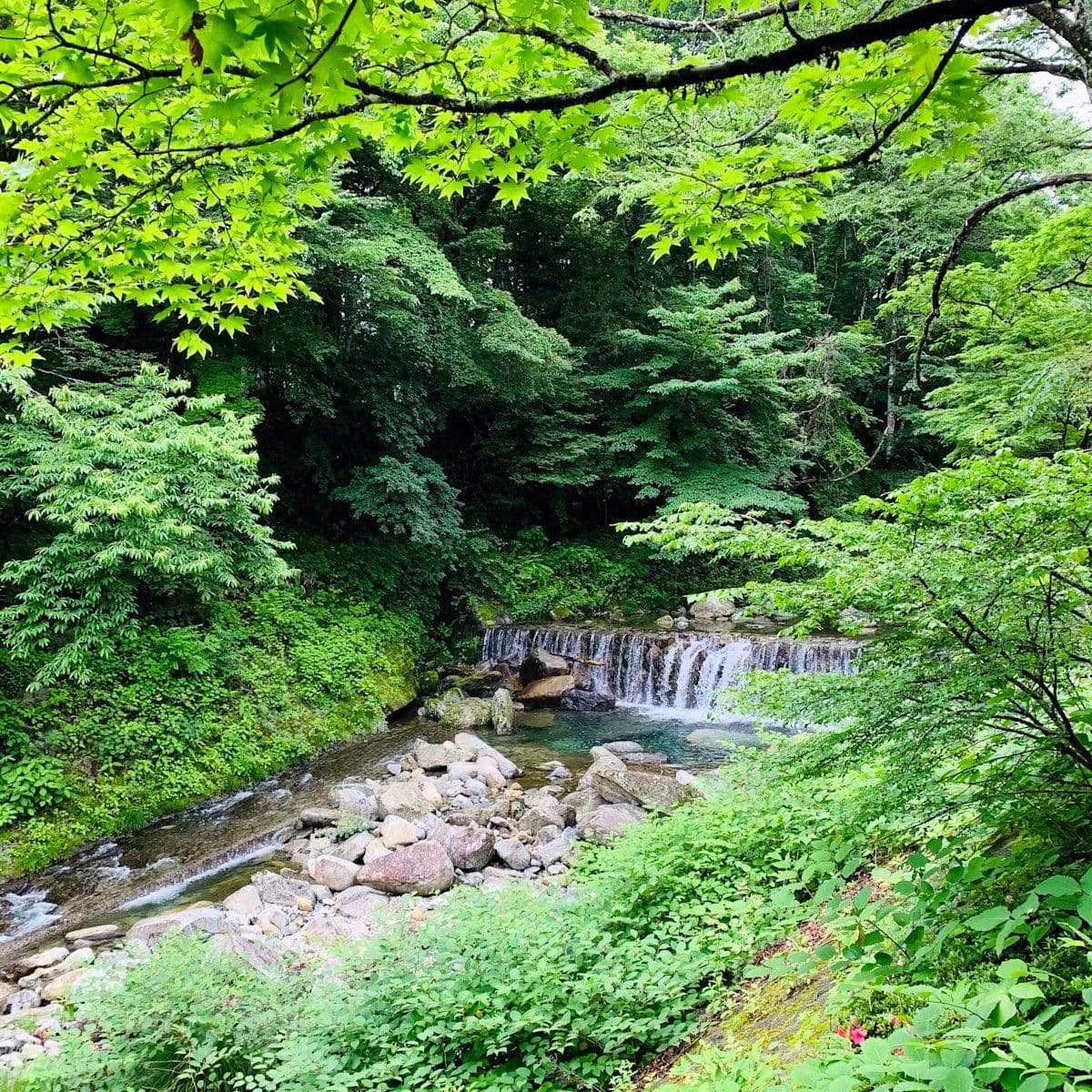
Genbikei is the louder sibling. Here the Iwai River does not drift; it accelerates, dropping through a compressed channel of dark rock, carving potholes and small falls, throwing spray where the water hits stone. The gorge is short, the formations are dramatic, and the whole place can be walked in well under an hour. There is no boat and no admission fee. You simply arrive, cross the bridges, and follow the water. The scale is intimate compared with Geibikei's towering walls, but the energy is the opposite extreme.
The flying dango
Genbikei's signature is one of the more peculiar food customs in Tohoku. A long-established shop sits on the far bank, beyond the rushing water, connected to the near side by a rope strung high across the gorge. The system, known locally as kakkou dango, works on trust and gravity. A visitor places coins in a wooden basket, strikes a wooden block to signal the shop, and the basket runs across the river on the rope. The shop loads it with skewered dango and a cup of tea, and sends the whole order skimming back over the churning water. Watching the basket sail above the rapids is half the appeal; eating the dango on a rock above the falls is the other half.
Nature
Tohoku's Hidden Waterfalls: Beyond the Famous Falls of Japan
Japan's famous waterfalls draw crowds; Tohoku's hidden waterfalls rarely do. A guide to the region's finest falls — from the Oirase cascades to the great falls of Akiu — and how to reach them.
Rock, falls, and the short walk
The walk itself is the main event aside from the dango. Bridges and a riverside path let you look straight down into the most violent stretches, where the Iwai has scoured the rock into smooth basins and abrupt drops. In spring the surrounding slopes flush green; in autumn the maples turn the gorge walls red and gold above the white water. Because the route is free, flat in places and steep in others, and quickly covered, Genbikei rewards travelers who want intensity without commitment. It also pairs easily with a longer day, since it asks for so little time.
How to Tell the Two Iwate Gorges Apart
The names cause most of the trouble. Geibikei and Genbikei differ by a single syllable, and both translate loosely to a sense of soaring or dramatic scenery. The experiences, however, sit at opposite ends of a spectrum, and a few contrasts settle the matter for good.
A simple contrast
Geibikei means a boat. The water is calm, the gorge is long and deep, the cliffs are tall limestone, and the activity is a ninety-minute ride with a paid ticket. The mood is slow and contemplative. Genbikei means a walk. The water is wild, the gorge is short and rocky, the appeal is the flying dango and the rapids, and entry is free. The mood is lively and quick. If a traveler wants to sit still and be carried, Geibikei answers. If they want to move, look down at fast water, and catch a basket of dango, Genbikei does.
Which suits which traveler
Families with restless children, photographers chasing dramatic close detail, and anyone short on time tend to prefer Genbikei, where the rewards come fast and cost nothing to access. Travelers drawn to atmosphere, to a boatman's song and the slow reveal of a canyon, and those who appreciate a structured outing with a clear beginning and end, gravitate to Geibikei. Many visitors do both, since the contrast is the entire pleasure. Seeing them on the same trip turns a pair of confusingly named stops into a deliberate study in opposites.
Combining the Gorges with Hiraizumi
Both gorges share a base in Ichinoseki, which also serves as the jumping-off point for Hiraizumi, the small town whose Buddhist temples and gardens hold UNESCO World Heritage status. The geography makes a combined itinerary straightforward, and the contrast between the gorges and the temples gives a day or two its shape. A morning of moving water and an afternoon of still gardens balance each other well.
A one-day plan
A focused day can take in one gorge and Hiraizumi. A common pairing is a morning at Genbikei, which needs little time, followed by an afternoon among Hiraizumi's temples such as Chusonji and Motsuji. Travelers willing to move quickly sometimes add a Geibikei boat ride as well, though doing all three in a single day leaves little room to linger and depends heavily on bus and train timing. Treating the gorges and Hiraizumi as separate halves of a day generally produces a calmer trip.
A two-day plan
Two days remove the pressure. One day can be given to Hiraizumi, with its gardens designed around Buddhist notions of paradise and its hilltop temple complex deserving unhurried attention. The other can hold both gorges, with the Geibikei boat ride in the morning and Genbikei's flying dango in the afternoon, or the reverse. Spacing things this way lets each place register on its own terms rather than blurring into a checklist, and it leaves margin for the slow rural transport that links them.
Getting There, Seasons, and Winter Boats
Access for both gorges begins at Ichinoseki Station, which sits on the Tohoku Shinkansen line and is therefore reachable directly from Tokyo and Sendai. From there the two gorges require different connections, a fact worth fixing in mind before setting out, since confusing the two routes is as easy as confusing the two names.
Reaching each gorge
For Geibikei, take the JR Ofunato Line east from Ichinoseki to Geibikei Station; the boat dock sits a short walk from the station. For Genbikei, there is no convenient train, so a local bus from Ichinoseki Station is the standard route, dropping visitors near the gorge and its dango rope. Because rural train and bus schedules can be sparse, checking departure times in advance prevents long waits, particularly when trying to combine both gorges in one day.
Best seasons and the winter kotatsu boat
Both gorges shift markedly with the seasons. Cherry blossom softens the spring, deep green fills the summer, and snow lines the cliffs and rocks in winter. Autumn draws the largest crowds, when maples set the limestone and the rapids against fierce color; for many travelers this is the season worth planning around. The Geibikei boat operates year-round, and in the cold months the craft are fitted with kotatsu, the heated tables found in Japanese homes, so passengers can glide between snow-dusted cliffs while staying warm. The winter ride is quieter and, to some tastes, the most memorable version of the trip.
Frequently Asked Questions
What is the difference between Geibikei and Genbikei?
Geibikei is a calm, deep gorge experienced from a poled wooden boat on the Satetsu River, with tall limestone cliffs, a boatman's folk song, and a ninety-minute round trip that requires a ticket. Genbikei is a short, turbulent rocky gorge on the Iwai River that you walk beside for free, best known for the flying dango sent across the water on a rope. In short, Geibikei is a boat ride and Genbikei is a walk.
What is the flying dango at Genbikei?
Flying dango, or kakkou dango, is a custom at Genbikei in which a shop on the far bank of the gorge delivers food across the rushing river by rope. Visitors place money in a wooden basket, knock a block to signal the shop, and the basket runs back loaded with skewered dango and tea. The sight of the order sailing over the rapids is part of the draw.
Does the Geibikei gorge boat run in winter?
Yes. The Geibikei boat operates throughout the year, and in winter the boats are fitted with kotatsu heated tables so passengers stay warm while passing between snow-covered cliffs. Many travelers consider the winter ride the most atmospheric, with quieter water and a hushed, snow-lined gorge.
How do I visit both gorges and Hiraizumi?
Use Ichinoseki Station as a base. Reach Geibikei by the JR Ofunato Line to Geibikei Station, and Genbikei by local bus from Ichinoseki, while Hiraizumi sits a short train ride away on the main line. One full day can cover a single gorge and Hiraizumi comfortably; two days allow both gorges and unhurried time among Hiraizumi's temples and gardens.